
Direct Summary: Selecting a Ready Mix Concrete (RMC) supplier involves more than comparing base cubic rates. To safeguard project structural integrity and timelines, B2B procurement managers must evaluate computerized batching reports, active transit mixer fleet sizes, QC testing laboratories, and dedicated on-site engineering support.
Benchmark 1: Fully Computerized Batching Systems
Ensure the supplier uses a SCADA-controlled, computerized wet-batching system rather than manual gates. A computerized plant automatically adjusts weight measurements and documents raw materials to the exact kilogram. You should request computerized batch weight logs (the ticket printout detailing sand, aggregate, cement, and admixture weights) for every single delivery to verify product transparency.
Benchmark 2: Plant Location and Transit Mixer Fleet Size
Hydration begins the moment water touches cement. According to standard specifications, concrete must be placed and compacted within **120 minutes** of batching (or longer if hydration retarders are used). Choosing a supplier with a plant located near Trichy Outer Ring Road (like Rockfort at Gundur SIDCO) ensures fast transit times to local sites.
Additionally, check the supplier's active transit mixer fleet size. A supplier with only 2 or 3 mixers cannot maintain continuous pours for large foundation rafts, which leads to cold joints and compromises structural integrity.
Benchmark 3: In-House NABL-Calibrated QC Laboratory
A reliable supplier must maintain an active quality control lab on-site to run standard checks, including:
- Aggregates sieve analysis and sand silt-content tests.
- Compression testing machines to crush specimen cube samples at 7-day and 28-day intervals.
- Automatic moisture correction probes for sand batch adjustments.
You should inspect the laboratory and ask for calibration certificates for the compression testing equipment to ensure testing accuracy.
Benchmark 4: Pumping and Placement Capabilities
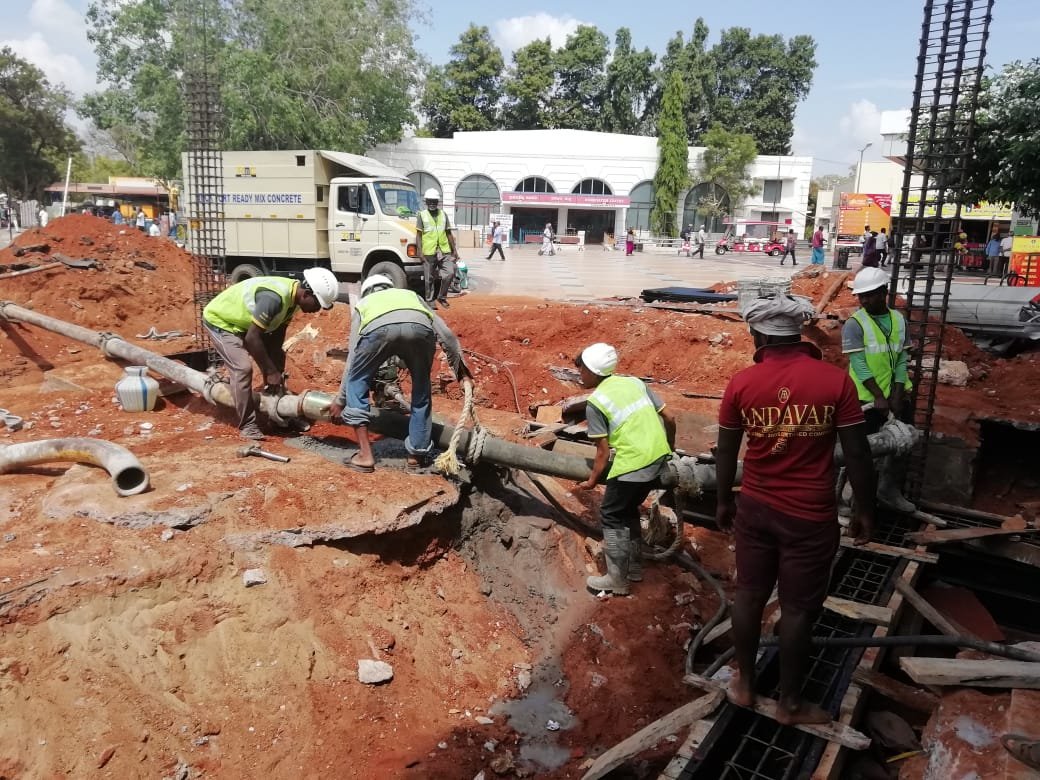
Verify whether the supplier owns concrete pump equipment (such as trailer line pumps or vertical boom pumps). Pumping concrete requires precise control over workability and mix design. Coordinating both concrete delivery and pump operations through a single supplier eliminates site coordination delays and avoids scheduling conflicts.
Benchmark 5: Site Support and Complaint Resolution
Many suppliers disappear once the delivery invoice is paid. Choose a partner that offers direct communication channels (such as phone and WhatsApp) to their plant supervisors. A dedicated QC engineer should be available on-site during large pours to handle slump adjustments and guide placement teams.